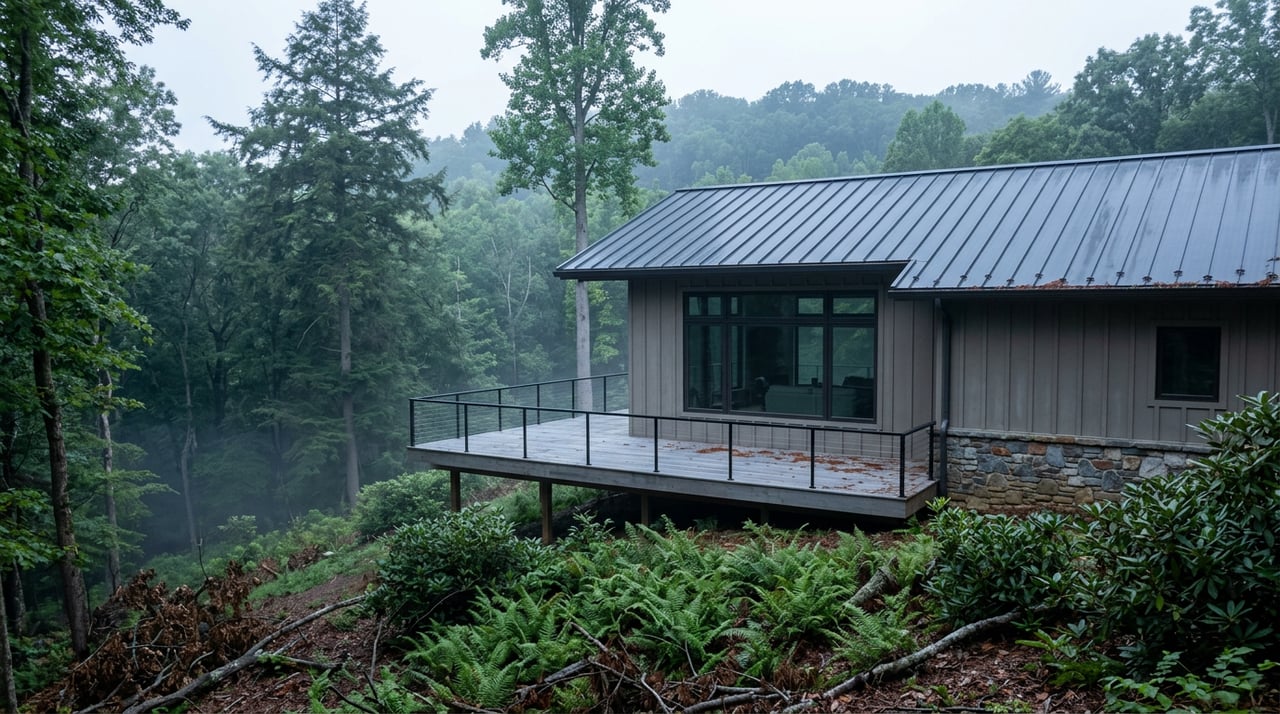
Picture two three-bedroom houses, both listed for roughly the same price this month. One sits in a quiet pocket just inside Asheville's city limits. The other is a fifteen-minute drive out, still in Buncombe County, still close enough to walk into for coffee downtown on a Saturday. Same bones, same rough price tag, same mountain views out the back window.
If your plan for either house includes renting it out on Airbnb or Vrbo while you're not there, they are not the same investment. One of them can legally do that. The other, in most cases, cannot. And the difference has nothing to do with the house itself.
The Rule That Changed in 2018
Inside Asheville's city limits, whole-home short-term rentals have been banned in most residential zones since the city council acted in January 2018. The only place a new whole-house vacation rental is allowed by right is the city's Resort zoning district, a small slice of the map, not most neighborhoods people actually shop for.
Everywhere else in the city, the legal path is a homestay permit, and it comes with real strings attached. The city's own homestay rules require that you live in the home full time, that the property sit in a residential zone, that you rent no more than one or two bedrooms, and that guest stays run under 30 days. Rent out the whole house instead of a room, and you've crossed into short-term vacation rental territory, which brings you right back to the resort-zone restriction. A handful of whole-home rentals that were already operating before the 2018 ban got to keep going under grandfathered status, but that inventory is fixed. It doesn't grow.
A Few Hundred Yards Changes Everything
Step outside the city boundary into unincorporated Buncombe County and the rulebook flips. County zoning treats vacation rentals as a permitted use across nearly every district it maps. Up to two single-family homes on a parcel, a combined floor area capped at 9,000 square feet, and no county license standing between a homeowner and a first guest, according to Mountain Xpress reporting on the city's enforcement struggles. No annual renewal. No owner-occupancy requirement. The same house that would need a homestay permit inside city limits can operate as a full-time, whole-home vacation rental a short drive away.
Here's the comparison side by side:
| City of Asheville | Unincorporated Buncombe County | |
|---|---|---|
| Whole-home rental allowed | Only in Resort zoning or grandfathered pre-2018 | Yes, by right in most districts |
| Owner must live on site | Yes, for any homestay | No |
| Permit or license required | Yes, annual renewal | No |
| Size or unit cap | 1-2 bedrooms for homestays | Up to 2 homes, 9,000 sq ft combined |
| Enforcement approach | Complaint-driven, with fines | Minimal, tax registration only |
That table looks tidy. The market underneath it is not, because the line dividing these two columns is not fixed.
The Rewrite That's Been Almost Happening Since 2023
Buncombe County has been sitting on a proposal to tighten its own rules since late 2023, a stretch now closing in on three years. In December 2023, the county planning board took up text amendments that would confine new vacation rentals to commercial zoning districts, a shift tied to the county's broader Buncombe 2043 Comprehensive Plan, according to reporting from The Valley Echo. The plan's own memo cited data showing vacation rentals made up roughly 34 percent of lodging sales in 2022-23 and pointed to more than 5,200 active short-term rental units as of 2022, representing about 4.5 percent of the county's housing stock and accounting for just over two-thirds of the county's rental housing gap.
By April 2024, the planning board hadn't voted yes. It voted to wait. Board chair Nancy Waldrop told a packed room at A-B Tech's Ferguson Auditorium that the process had moved too fast and pushed the decision back 100 days, according to Mountain Xpress. As of this writing in late August 2026, the county has not revived that vote. It also has not withdrawn the proposal. That's a strange kind of limbo for anyone buying a county property today with rental income in the pro forma. The permissive rules described above are what's on the books right now, not necessarily what's on the books in three years.
The Line Doesn't Stop at the County Line Either
It would be simpler if "inside the city" and "outside the city" were the only two categories that mattered, but they aren't. Woodfin, Weaverville, Black Mountain, Montreat, and Biltmore Forest each maintain their own separate ordinances governing short-term rentals, distinct from both the city of Asheville's framework and the county's, per the same Mountain Xpress reporting. A buyer looking at Weaverville or Black Mountain with rental income in mind isn't just checking one boundary. They're checking which of several small-town rulebooks applies to that specific parcel, because none of them are required to match the county's more permissive stance or the city's stricter one.
What Enforcement Has Actually Looked Like
The rules only matter as much as the follow-through, and Asheville's follow-through has left a real paper trail. In the year after the city hired a third-party compliance service to identify unpermitted listings, the total number of available short-term rentals inside city limits dropped by nearly 25 percent measured from November 2016, according to WLOS reporting from that period. Homestay permits, the compliant path that survived the crackdown, grew sharply over that same stretch. One owner quoted in that coverage, Pete Kuehne, described losing his monthly income when he had to shut down his short-term rental, and said he didn't blame the city for enforcing its own rules. He went on to start a vacation rental management company instead.
Kuehne's name resurfaces years later in the county debate. At that same April 2024 planning board meeting where the vote got pushed back, he spoke again, this time in favor of pumping the brakes on the county's proposed restrictions, arguing that vacation rentals are a real driver of local commerce and tax revenue. It's a useful reminder that the people navigating these rules aren't abstract stakeholders. They're the same handful of operators and owners showing up at hearings on both sides of the city line, years apart, because the rules keep moving under them.
On the scale side, Asheville's own Planning and Economic Development Committee counted 861 registered homestays and 176 registered short-term rentals within city limits as of November 2023, per WUNC's reporting, which also traced short-term rental revenue across Buncombe County growing from $18.7 million in 2016 to $229 million in 2022, an increase of more than 1,000 percent in six years. That growth is exactly what pulled county officials toward the stalled 2023 zoning rewrite in the first place.
What This Means If You're Running the Numbers
None of this means investment property near Asheville is a bad idea. It means the zoning check has to happen before the offer, not during due diligence.
- Confirm the parcel's jurisdiction first, using the county's GIS lookup, before you fall in love with a listing photo or a projected nightly rate.
- If it's inside city limits, find out whether the zoning is Resort or something else, and whether any existing rental use is grandfathered from before January 2018.
- If it's in unincorporated county land, check current zoning against the 9,000-square-foot, two-home cap and register for the county occupancy tax before listing anywhere.
- If it's in Weaverville, Black Mountain, Woodfin, Montreat, or Biltmore Forest, request the specific municipal ordinance rather than assuming county rules carry over.
- Ask about HOA covenants separately. A city or county green light doesn't override a private restriction written into the deed.
- Build in the possibility that Buncombe County's stalled 2023 rewrite could resurface. A property that pencils out under today's rules should still make sense if the commercial-zone restriction eventually passes.
A Few Questions Worth Asking Directly
If a whole-home rental is grandfathered inside city limits, does that status transfer when the house sells? The nonconforming use generally attaches to how the property has continuously operated, not automatically to a new owner's plans, so confirm the property's specific permit history and any conditions before assuming continuity.
Could Buncombe County's stalled proposal come back? The planning board deferred its vote rather than rejecting the idea, and the underlying comprehensive plan that produced it is still in place, so a revival is a real possibility rather than a closed chapter.
Is a homestay permit inside Asheville transferable if I sell to someone who also plans to live there? Permits are generally tied to the operator's owner-occupancy, which means a new owner typically has to apply fresh rather than inherit the prior owner's approval.
If you're weighing a purchase anywhere near the Asheville city line with rental income as part of the plan, that boundary deserves the same scrutiny as the roof and the foundation. Andy Ball has spent years working through exactly this kind of zoning and land-use question as chair of the Buncombe County Board of Adjustment, and can walk you through what a specific parcel's jurisdiction actually allows before you write an offer. Explore the Asheville neighborhood guide or visit the buyer resources page to get started, and when you're ready to talk through a specific property, Let's Connect.
