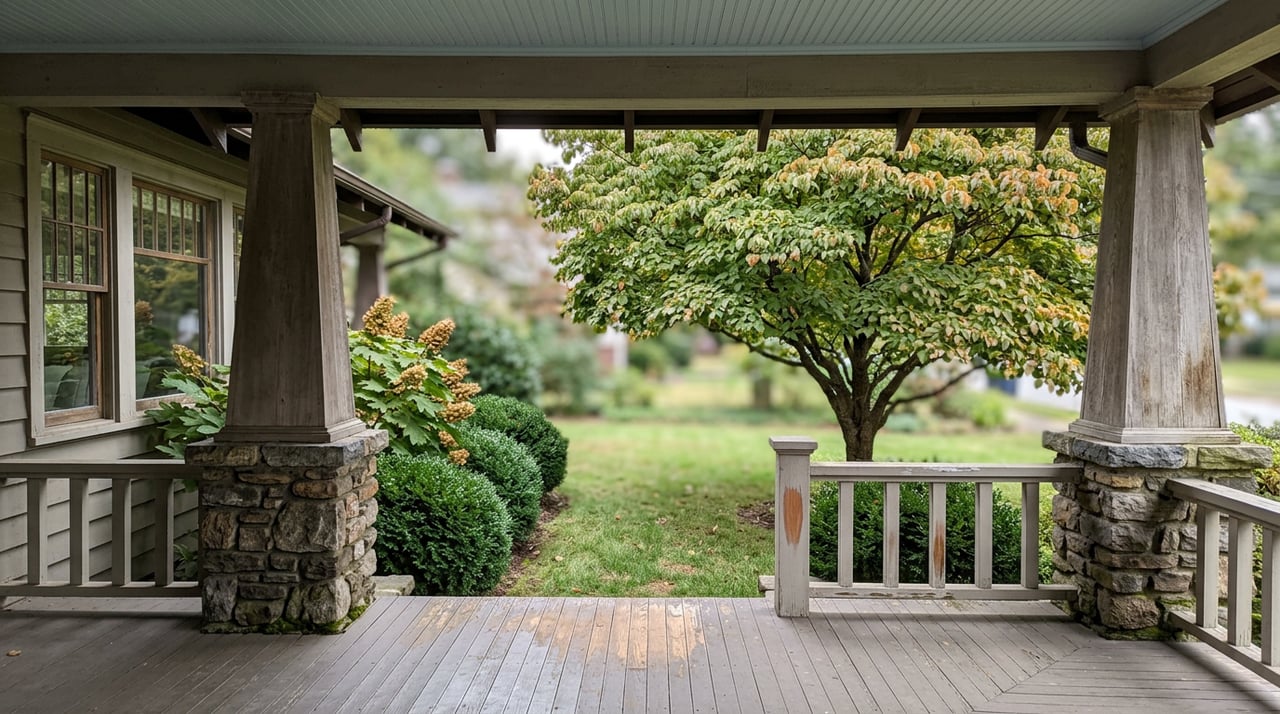
A buyer touring a 1920s bungalow off Haywood Road hears the word "historic" from the listing agent and files it away as a warning: repainting the porch, swapping a window, adding a rail might mean a trip to a city board first. That assumption is reasonable. It is also wrong for this particular house, and the gap between what buyers expect and what actually happens at the permit counter is worth understanding before an offer goes in, not after.
West Asheville's oldest streets carry real historic status. The commercial stretch of Haywood Road anchored by the old streetcar line is listed on the National Register of Historic Places as the West Asheville End of Car Line Historic District, a run of brick and concrete-block storefronts dating from 1916 through the mid-1930s. A few blocks over, the West Asheville-Aycock School Historic District covers the 400-block corridor built between 1915 and 1936. Both designations are real, both are federally recognized, and neither one requires a homeowner to ask the city's permission before changing a window.
Two Kinds of Historic, One Word to Describe Them
Asheville's own zoning framework draws a line that a National Register listing doesn't cross. The city's Historic Resources Commission reviews exterior changes and issues Certificates of Appropriateness, but only for properties inside one of four local historic overlay districts: Albemarle Park, Biltmore Village, Montford, and St. Dunstan's. That's the full list, according to the city's zoning administration page. A property can sit inside a nationally recognized historic district and still fall entirely outside that review process, because the National Register is an honorary and archival designation. It documents significance. It does not, by itself, regulate what an owner can do to the building.
Montford works the other way. Buy a home there and any exterior change, from a porch rail to paint color, needs a Certificate of Appropriateness before a building permit will even be issued. West Asheville's bungalows off Haywood Road and Michigan Avenue carry the historic pedigree without that second layer of review. The standard city building permit process still applies, the same as it would for a 1998 infill build three streets over. What doesn't apply is the design review that governs Montford or Biltmore Village.
This isn't a technicality that only matters to preservation hobbyists. It changes the actual math of buying one of these houses. A buyer weighing a fixer bungalow against a comparable Montford property should know that the renovation timeline and approval friction are not the same, even though both listings might use the word "historic" in the same sentence.
What the Age of the House Actually Requires
The historic-district question settles quickly once you check an address. The condition of the house underneath the roofline takes longer to sort out, and it's the part of the transaction that shows up on an inspection report rather than a zoning map.
Homes built in Asheville between the 1880s and the 1940s, which describes most of the original bungalow stock on and around Haywood Road, commonly have knob-and-tube wiring somewhere in the structure, whether in the attic, behind a wall, or spliced into a later renovation. The wiring itself isn't automatically dangerous. The problem is what decades of homeowners have done to it: modern junction boxes, dimmer switches, and extension circuits tied into a system that was never built to carry that load. A licensed electrician can confirm what's live and what's cosmetic, but the buyer should expect to budget for at least a partial rewire, and to have that conversation with an insurance carrier before closing, since many insurers are reluctant to write new policies on homes with active knob-and-tube.
Foundations and crawl spaces are the other recurring line item. West Asheville sits on the hillside terrain and clay soil that define most of the city west of the French Broad, and local foundation contractors point specifically to the pre-war bungalows off Haywood Road as a common source of calls: floors that bounce underfoot, joists softened by decades of damp crawl-space air, beams that need sistering or full replacement before a floor is level again. None of this is unique to West Asheville, but it is close to universal in a housing stock this age, and it's worth having a foundation specialist walk the crawl space separately from the general home inspector if the report flags any sag or moisture.
The River Redrew the Map, Not Just the Damage
Flood risk is the third piece of due diligence that changed for buyers in this part of Asheville, and it changed for a specific reason. Hurricane Helene put the French Broad at a record crest in September 2024, and the flooding that followed didn't stay inside the boundaries FEMA had drawn. The city's own climate resilience page states plainly that major flooding can happen outside mapped floodplains and floodways, and that Helene proved it. Properties that had never carried flood insurance, because they were never required to, took on water anyway.
That doesn't mean every West Asheville bungalow near the river is at elevated risk. It means the FEMA flood zone designation on a listing sheet is no longer a complete answer to the question of whether a property could flood. A buyer evaluating a home in the lower-lying stretches near the river should ask directly whether the property took on water during Helene, what if any remediation was done, and whether flood insurance is worth carrying regardless of the official zone. It's a harder conversation than checking a box on a disclosure form, but it's the one that actually reflects what happened here two years ago.
What to Ask Before You Write the Offer
A few questions turn all of this from background knowledge into something a buyer can act on before a contract is signed:
- Is this address inside one of Asheville's four local historic overlay districts (Albemarle Park, Biltmore Village, Montford, St. Dunstan's), or inside a National Register district like End of Car Line or Aycock School? The city's GIS mapping system will answer this directly, and it's worth checking even when an agent describes a property as historic, since the two designations carry very different renovation timelines.
- Has an electrician, not just the general home inspector, confirmed whether knob-and-tube wiring is present and whether it's still live in inaccessible areas?
- Has the crawl space been inspected separately for joist and beam condition, particularly if the inspection report notes any floor bounce or moisture?
- Regardless of FEMA flood zone status, did this property take on water during Helene, and is flood insurance worth carrying anyway?
None of these questions should stop a buyer from moving forward on a bungalow they love. They should change what the buyer budgets for after closing and how quickly they expect to be able to touch the exterior.
A Short FAQ
Does a National Register listing without local overlay status mean there are no rules at all? No. Standard city building permits still apply to any structural work. What's absent is the added Certificate of Appropriateness review that Montford, Biltmore Village, Albemarle Park, and St. Dunstan's require for exterior changes.
Is knob-and-tube wiring an automatic dealbreaker? Not automatically, but it's a real cost and insurance consideration. Many carriers won't write new policies on a home with active knob-and-tube, and lenders sometimes require remediation before closing.
If a house isn't in a FEMA-mapped flood zone, is it safe from flood risk? Not necessarily, based on what happened during Helene. The city has said outright that major flooding occurred outside official floodplain and floodway boundaries, which is why asking about a property's actual flood history matters more than checking a map.
If you're weighing a bungalow on Haywood Road against something in Montford, or you just want a second set of eyes on what a historic designation actually means for a specific address, Andy Ball has walked buyers through this exact conversation more than once. Let's Connect and figure out what this house, specifically, is going to ask of you.
